I was looking for book recommendations: non-fiction, but not a heavy read. After working the whole day and taking in a lot of information (now that we use AI all day, there is a lot more information to process), I was feeling overwhelmed, but I still wanted to read some non-fiction. So, of course, I asked AI to recommend some non-fiction books that I would like.
One of the recommendations was Fuzz, and it drew my attention because it is about wildlife, which is something I like, as you can see in my wildlife posts and in my learnings from An Immense World.
So I logged into my public library website and put a hold on it, and it was available right away, as it doesn’t seem to be a book that interests a lot of people.
But the book was really nice. It was really interesting to see how people and wildlife relate to each other, and also the conflicts that arise from it. The book covers a lot of subjects, from bear attacks and how bears relate to people, to simpler and smaller animals like rats and gulls.
It was for sure an enjoyable read, and I learned some interesting things.
This post is part of the series Learnings from books where my goal is to share what I learned from the book that I read. It is a mixture of review and summary with a bit of my opinion and point of view. But, as reviews, these learnings can say more about me than the book itself, so I trust that you the smart reader will take it with a grain of salt.
Learnings from the book Fuzz
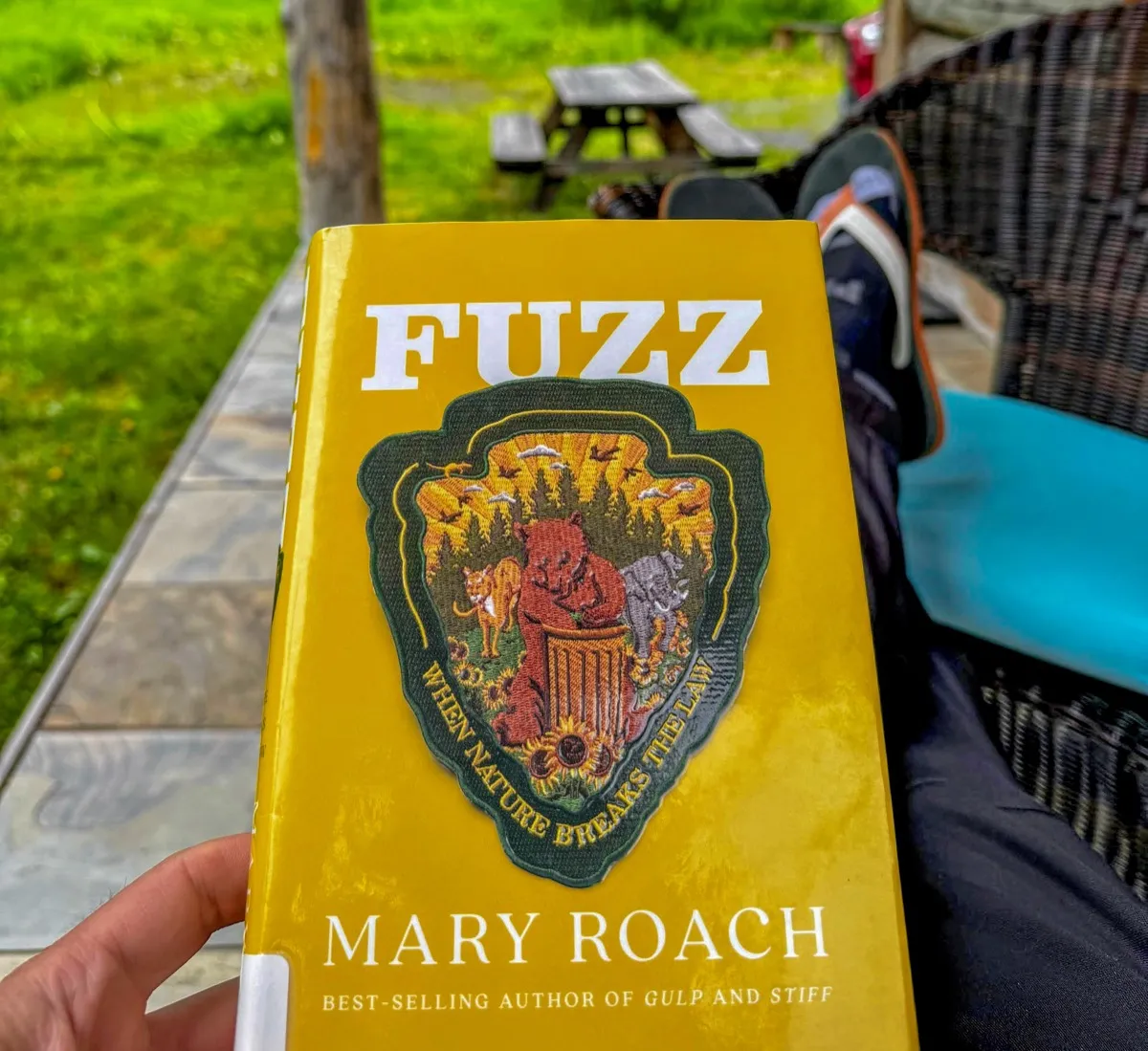
Finishing Fuzz on the porch of our cabin in Moose Pass, Alaska
Here are the most interesting facts and things that I learned in this book.
Animals used to be put on trial
The book opens with a story I had never heard: in the past, magistrates and church leaders put animals like rats, weevils and moles on trial for destroying crops. Of course, the animals could not understand property law, so the trials were not about them. They were a show for the people: even nature must bend to our rule. One sixteenth-century judge even granted leniency to moles with young offspring, to show not only his authority but also his compassion.
Bears and cougars kill in different ways
Bears are omnivores. They eat nuts, berries, fruit and grasses, and scavenge trash and carrion, so they don’t regularly kill to eat, and their teeth evolved for crushing and grinding. That makes them inelegant killers, and the wounds they leave are cruder.
Cougars are true carnivores. They live by killing, so they kill efficiently: they stalk hidden, pounce from behind and deliver a “killing bite” to the back of the neck, with molars that close like scissors.
Never run from a predator
The worst thing you can do when a predator seems ready to attack is to turn and run, especially from a hunter like a cougar. Running (or mountain biking) away triggers the predator-prey response, and once that switch is on, it stays on for a surprisingly long time.
If the animal attacks anyway, the advice in the book is to fight back, and with a bear, go for the face. I found this one surprising, as I always heard that you should play dead, and that is still the usual advice for a grizzly that attacks to defend itself, so it is worth reading the local guidance before going into bear country.
Garbage is a killer
As the book says, prevention is better than punishment, and the safest thing for both species is to keep them apart. Bears that learn to associate humans with easy meals end up in trouble, so people in bear country need to secure their garbage, stop feeding birds and not leave dog food on the porch.
Living in British Columbia, where I have photographed black bears, this one hit close to home.
Killing does not solve the problem
Killing is a common tool to control problem animals, but the book argues that, unless the whole population is wiped out, it doesn’t work. The great hope is that science will come up with a way to impose birth control on problem animals instead.
Animals misjudge cars
Prey animals keep what is called a spatial margin of safety. They can judge the distance to a predator and know exactly how close they can let it come before running away, the flight initiation distance (FID). They shorten it when the food is good and lengthen it when the predator comes running, and they almost always get it right. Unless the thing coming at them has an engine.
The book also has some advice for drivers: don’t brake hard or swerve for a small animal, no matter how cute, and never speed in moose country. For deer, there is no clear answer: brake or swerve only when there is space to do it safely, never to the point of losing control.
Fun fact: I finished reading this book in our cabin in Moose Pass, during our trip to Alaska.
We are irrational about which species we protect
We all have emotional connections to some branches of the tree of life. Big and beautiful animals, the charismatic megafauna, get the most protection, even when they are not endangered, like the cougars in California (at least when the book was written). The book gives the example of a man who won’t eat octopus because of its intelligence, but eats pork and buys glue traps for rats, both likely more intelligent than octopuses. And it asks: why is intelligence, or size, the scale we use to decide whom to spare?
Favorite quotes
“If a tree falls in the forest and no one is there to hear it, that’s a shame.”
“Depending on your species, religion, gender, and caste, India may be a better place to be an animal than it is to be a human.”
“Here’s the thing with killing as a wildlife damage control tool. It isn’t just mean. It doesn’t—barring wholesale eradication—work.”
“As with a gold rush, so with farming: the people who make the most reliable living are the ones who sell the supplies to everyone else.”
“Trees are vulnerable, peaceable, innocent. Plants in general have that vibe. Don’t be fooled.”
These are my learnings from the book Fuzz: When Nature Breaks the Law written by Mary Roach. A special thanks to my public library for allowing access to the book for free.
Cheers.