Not sure if it was on purpose or not, but this was our volcano year.
We hadn’t seen many volcanoes before, but this year we went to Hawaii, where we saw an active volcano spewing lava from far away. We also went to Iceland, which has a very active volcanic region. Earlier on this same trip, in Yogyakarta, Mount Merapi stayed hidden in the clouds the whole time. We were really unlucky with volcanoes. But one thing I still wanted to do was climb an active volcano, and “hike a volcano” was one of the goals on our plan for this trip.
My wish was to see lava up close, but that is very hard, because it depends on a lot of variables. The closest I could get on a short trip was hiking up Mount Bromo in East Java. It has no lava flows, but it is always active, with gas coming out of the crater.
It was a bit of a detour from our main route, but we thought it was worth it.
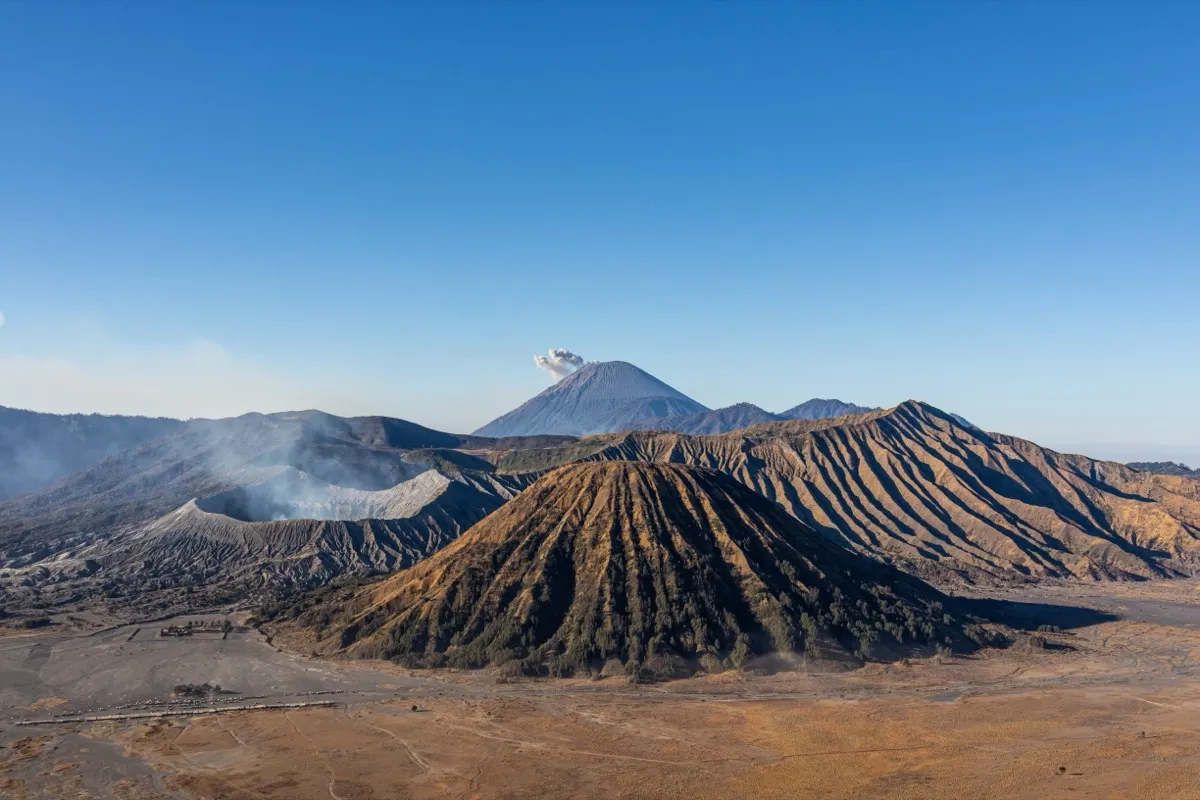
Mount Batok and Mount Semeru erupting behind it, over the Sea of Sand. Get this photo on Adobe Stock
The park was closed
Before we even got there, we almost had to cancel. On the day we left Bukit Lawang, we found out that Bromo Tengger Semeru National Park, where the volcanoes are, had been closed since September 12 due to wildfires, with no reopening date.
So we had two choices. We could cancel Bromo and spend the extra days in Yogyakarta, or we could go anyway, without knowing if we would be able to climb the volcano.
We didn’t like Yogyakarta that much, so we decided to go. Even if we couldn’t climb, at least we would be somewhere different, with different scenery.
And we got really lucky: on the day we arrived in Cemoro Lawang, the park announced it would reopen the next morning. So the day we had planned for the volcano was the first day after the reopening.
Getting to Cemoro Lawang
Cemoro Lawang, the village at the edge of the crater, isn’t that easy to get to. It’s around two and a half hours by car from Surabaya, and we were coming from Yogyakarta, so we first took the Sancaka train in executive class to Surabaya. I bought the tickets on Traveloka on the day sales opened, two months ahead, to get good seats. The train left at 6:45 AM and arrived at Surabaya Gubeng around 10:45.
A driver picked us up at the station, and we got to the hotel around 1:40 PM, so the whole journey took us about seven hours. The transfer from Surabaya was 900k IDR, arranged by the hotel over WhatsApp, as they never replied to my messages on Booking.com. The car smelled of cigarettes and my seatbelt didn’t work.
We stayed at Cemara Indah Hotel for two nights, in a standard double room with breakfast. The main thing to do there is a sunrise tour to see the volcanoes from above, and we didn’t want to spend hours getting there, stay one night and leave right after.
The hotel was simple. The bed was average and the shower was weak, but the breakfast was good, closer to a lunch than a breakfast, which seems to be common in Indonesia.

View from the hotel. Get this photo on Adobe Stock
The sunrise tour
We booked a private Jeep tour with the hotel and paid 1.1M IDR for the two of us, park fees included. We woke up at 2:20 AM, our driver was already waiting at 2:50, and we got to King Kong Hill around 3:50, more than an hour before the sunrise. In my opinion it was a bit too early, but the Jeep traffic jam is huge. If you don’t get there very early, you risk getting stuck in traffic and missing the sunrise, or having to rush.

People waiting for the sunrise on King Kong Hill
It was cold at the top, and a bit windy, even with a base layer and a windbreaker. It’s incredible how quickly it warms up once the sun is out. From there, we could also see Mount Semeru, the highest mountain in Java, puffing out smoke. The sunrise was beautiful, but for me it was overrated and not worth the 2:20 AM wake-up. The view right after it is better, with the sun shining directly on that side of the volcanoes.

Sunrise from King Kong Hill. Get this photo on Adobe Stock
Climbing to the crater
After the sunrise, all the Jeeps drive down to the Sea of Sand and stop there, so you can walk up to the crater of Bromo. I started the hike around 6:45 AM. The walk across the sand to the crater is about 3 km, passing next to Luhur Poten, a Hindu temple in the middle of the Sea of Sand.
One thing that surprised me: I thought Bromo was the pointy, perfectly shaped volcano you see in all the photos, but that one is actually Mount Batok. Bromo is the flatter one next to it, with the smoking crater.

Me in front of Batok and Bromo
If you don’t want to walk across the sand, you can ride a horse to the bottom of the crater, but you still need to walk up from there. I walked the whole way, because that was the experience I wanted.
The climb itself is easy, since there are around 250 concrete steps all the way to the rim.
The smell up there is really strong. Sometimes it even hurts your nose, but depending on the wind, you barely smell it. The sound is interesting as well. People compare it to a jet engine. It’s not that loud, but there is a constant roar of steam coming from the crater.

Me at the crater, with steam coming up
I was planning to climb Mount Batok afterwards, but it is too steep, more like climbing than hiking, so I gave up and walked back to the hotel instead.
I was back at the hotel around 9 or 9:30, early enough to still have breakfast there.
Seruni viewpoint, the alternative to the Jeeps
On our last morning, I woke up at 5:30 and hiked to the Seruni viewpoint to see the volcanoes one more time, especially Semeru. It took around 45 minutes, and the view was almost as good as, if not better than, the one from King Kong Hill. If you are staying in Cemoro Lawang, it’s a good alternative to the sunrise tour, without the 2:20 AM wake-up or the Jeep traffic. That was actually my original plan before the trip: walk from the village to Seruni Point in the dark, then down into the Sea of Sand to the crater, skipping the Jeeps completely. You only need a headlamp, warm clothes and the park ticket.

The view from Seruni viewpoint

The village on the way to Seruni viewpoint. Get this photo on Adobe Stock
The rest of our stay
That’s basically all there is to do in Cemoro Lawang.
After the crater, we spent the rest of the day resting at the hotel, watching movies and drinking some beers while watching the sunset.
A really good place to eat is Kusuma Kitchen, where we ate twice. They have good local food, which is what I tried, but also good hamburgers, which my wife liked and ordered on both days.

Lunch at Kusuma Kitchen
Looking back, one night would probably have been enough, as there isn’t much to do on the second day. But it was also good to take a break halfway through our trip and do nothing, just resting and watching TV shows. If you want to fill a second day, Madakaripura Waterfall and the green Teletubbies Hill on the south side of the caldera were on my list, but we didn’t go.
On our last day, a driver took us back to Surabaya, this time to the airport, and we flew to Labuan Bajo, where we did our first scuba dives.
Final thoughts
One thing I didn’t like is that you have to pay a fee to enter the village. We paid 70k IDR, and I felt the driver charged us more than he should have and kept some of it.
The way things worked also felt a bit dishonest. The Jeep never stopped at the park gate for a check, and we never got a national park ticket, even though we paid for one. I’m not sure what happened, but it looked sketchy, and it felt like people were taking advantage of tourists.
Even with those annoyances, it was a lot better than expected and worth the detour. Hiking up an active volcano was a unique experience, the views of Bromo, Batok and Semeru were amazing, and after almost giving up because of the closure, we felt lucky to make it at all.
If you’d like to see more photos from this trip, they are available in my Indonesia collection on Adobe Stock.
Cheers.